Nerve Armor: Formula, Ingredients & Buyer Information
A label-first guide to Nerve Armor, including its five-ingredient formula, Supplement Facts, current package information, safety context and independent ingredient research.
Current purchase terms can change. Verify price, shipping and checkout details on the purchase page before ordering.
What is Nerve Armor?
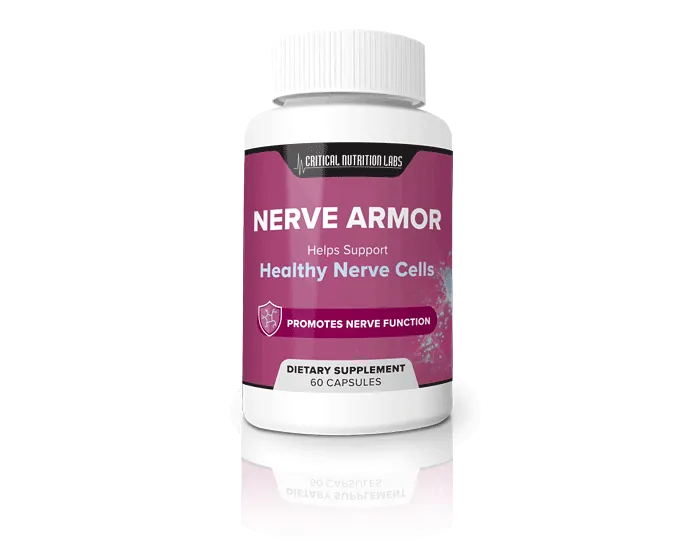
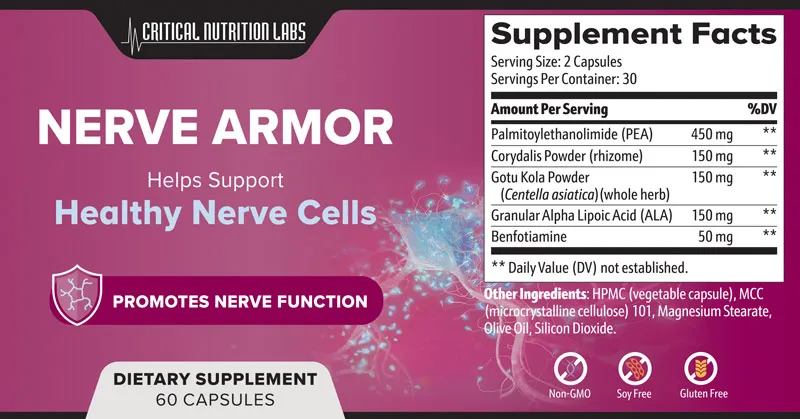
Nerve Armor is a dietary supplement sold under the Critical Nutrition Labs brand. The supplied product label lists palmitoylethanolamide (PEA), corydalis powder, gotu kola powder, alpha-lipoic acid (ALA) and benfotiamine. The bottle contains 60 capsules, with two capsules listed as one serving.
This site treats the current product label as the primary source for formula amounts. Seller marketing statements are described as seller-reported claims, while ingredient research is discussed separately so that studies on a single ingredient are not presented as proof that the finished Nerve Armor product has been clinically proven.
Five ingredients listed on the Supplement Facts panel
PEA
Palmitoylethanolamide, a naturally occurring fatty-acid amide studied in pain and neuroinflammatory research.
PEA research guide →Corydalis
Corydalis rhizome powder, a botanical used in traditional practice and studied for multiple alkaloids.
Corydalis guide →Gotu Kola
Whole-herb Centella asiatica, a botanical with triterpenes investigated across several biological systems.
Gotu kola guide →Alpha-Lipoic Acid
An antioxidant compound involved in cellular redox biology and studied in diabetic polyneuropathy.
ALA guide →Benfotiamine
A thiamine derivative. Recent clinical research has produced mixed findings depending on study design and endpoint.
Benfotiamine guide →Other ingredients
The supplied label also lists HPMC vegetable capsule, microcrystalline cellulose, magnesium stearate, olive oil and silicon dioxide.
Read the label guide →
How we discuss “how it works”
The product label uses structure/function wording such as supporting healthy nerve cells and promoting nerve function. Our explanation stays within that context. Ingredient pages discuss what researchers have investigated—such as PEA signaling, antioxidant biology, thiamine metabolism and botanical constituents—while clearly separating those studies from finished-product evidence.
The FDA distinguishes structure/function claims from disease-treatment claims and notes that dietary supplements are not FDA-approved to treat or prevent disease. That distinction matters for both consumer understanding and responsible affiliate content.
Compare Nerve Armor package options
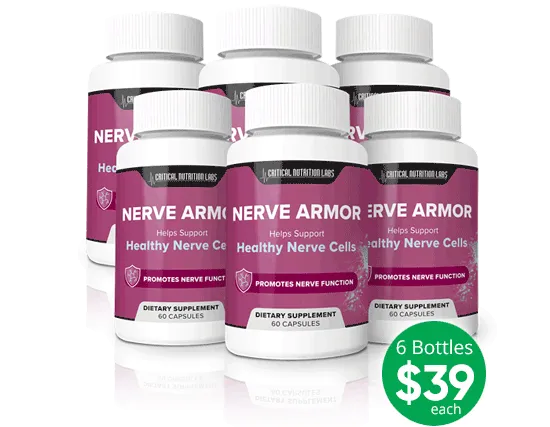
Current pricing used for this guide shows $59 for the 1-bottle option, $49 per bottle for the 3-bottle option and $39 per bottle for the 6-bottle option. Verify the current price, shipping and checkout terms on the purchase page before ordering.
30 servings1 Bottle
$59 each*
Useful for buyers who prefer the smallest upfront order.
View Current Price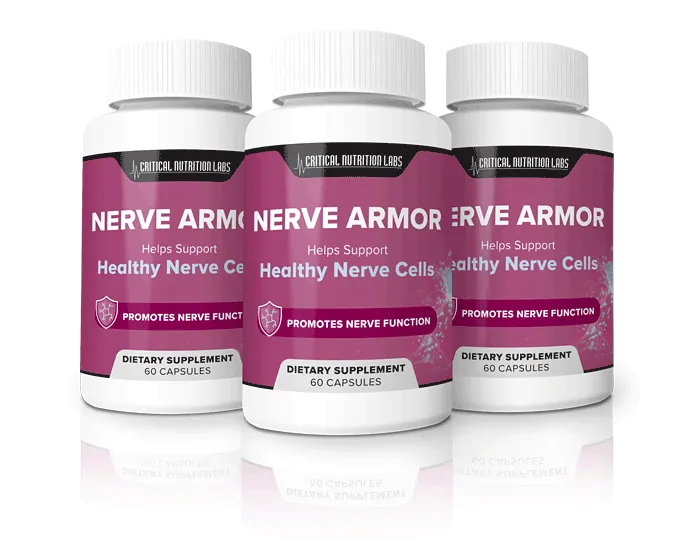 90 servings
3 Bottles
$49 each*
Seller-supplied package image shows $49 per bottle.
Check 3-Bottle Option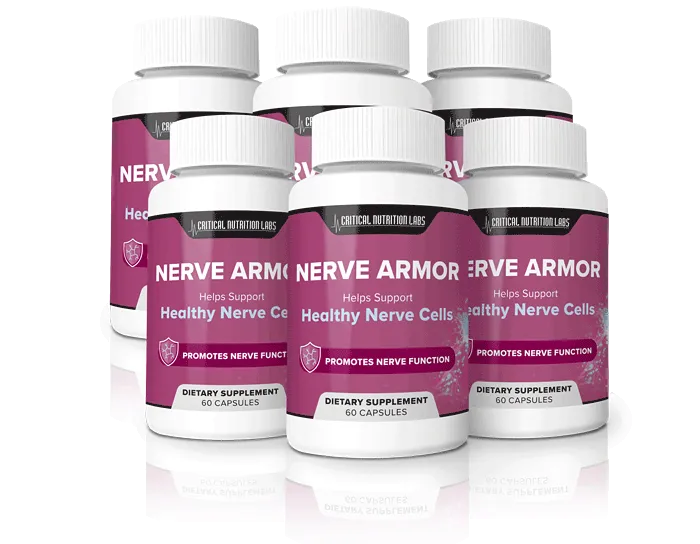 180 servings
6 Bottles
$39 each*
Seller-supplied package image shows $39 per bottle.
Check 6-Bottle Option*Package graphics supplied for this build. Confirm current price, shipping, taxes and checkout terms before ordering.
60-day seller guarantee
The supplied Nerve Armor guarantee graphic states a 60-day ironclad money-back guarantee. We describe this as a seller guarantee, not a promise made by NerveiArmor.com. Refund eligibility, return instructions and any conditions are controlled by the seller's current policy.
Keep your order confirmation and use the support instructions associated with your purchase if you need assistance.
Explore Nerve Armor and nerve-health topics
Buying Guides
Where to buy, package comparisons, authenticity checks, shipping and purchase-route questions.
Browse buyer guides →Ingredient Research
PEA, alpha-lipoic acid, benfotiamine, gotu kola and corydalis, with limitations clearly stated.
Browse ingredient research →Nerve Health Library
Educational articles on nerve signaling, myelin, nutrition, oxidative stress and supplement decision-making.
Browse nerve-health articles →Safety comes before marketing
Nerve-related symptoms can have many causes. A dietary supplement should not be used to self-diagnose or replace appropriate medical care. People who are pregnant or nursing, take prescription medicines, have a medical condition, or are preparing for surgery should discuss supplement use with a qualified healthcare professional.
Because Nerve Armor contains multiple active ingredients, potential interactions and individual tolerability matter. Our safety page separates known ingredient-level cautions from seller statements and avoids claiming that “natural” automatically means risk-free.
Read the safety and side-effects guide →
What the label can tell you—and what it cannot
The current label can answer concrete questions: which ingredients are listed, how much of each is present per serving, how many capsules are in the bottle, and which other ingredients are used. Those are the strongest product-specific facts available without laboratory testing.
The label cannot by itself tell you how much benefit a particular person will experience, whether a symptom has a certain cause, whether the formula is appropriate with a prescription medication, or whether a marketing mechanism translates into a meaningful clinical outcome. Those questions require different evidence.
This distinction is central to the site's editorial model. We use label facts for formula pages, dated seller information for commercial pages, government guidance for regulatory context, and peer-reviewed studies for ingredient research. The categories are not blended into one sales narrative.
Evidence hierarchy used here
- Current physical label — serving size and formula amounts
- Current checkout/seller information — price, shipping, guarantee
- FDA/NIH — regulatory and nutrient context
- PubMed-indexed research — ingredient-level evidence
- Seller marketing — described as seller-reported, not independently proven
What the independent ingredient literature looks like
| Ingredient | Research context | Important limitation |
|---|---|---|
| PEA | Systematic reviews include pain and neuropathic-pain studies. | Published reviews note high heterogeneity; formulations and doses vary. |
| Alpha-lipoic acid | Randomized studies and meta-analyses in diabetic sensorimotor peripheral neuropathy. | Disease-specific populations and doses are not the same as this formula. |
| Benfotiamine | Older short trials plus a 2026 randomized 12-month BOND study. | The 2026 study found no significant benefit across multiple neuropathy outcomes. |
| Gotu kola | Reviews of Centella asiatica and triterpenes across several biological systems. | Whole-herb powder may differ from standardized extracts used in research. |
| Corydalis | Traditional-use history and modern reviews of multiple alkaloids. | Plant species, preparation and alkaloid concentration can vary substantially. |
These research categories are not a clinical trial of the finished Nerve Armor product.
Five questions to answer before clicking “buy”
1. Do you understand the exact formula?
Read the Supplement Facts panel rather than relying only on the front-label benefit statement. Know the serving size and amounts, especially if you use other supplements with overlapping ingredients.
2. Are you comfortable with the evidence level?
Ingredient research can be informative, but it is not the same as a finished-product trial. If you need strong proof for a specific medical outcome, ask whether that evidence actually exists for this exact product.
3. Have you checked safety in your own context?
Medication use, medical conditions, pregnancy, nursing and surgery plans can change the risk-benefit discussion. A healthcare professional can review the full label against your history.
4. Do you understand the transaction?
Confirm package size, final total, shipping and any recurring-order terms. A lower unit price can require a larger upfront purchase.
5. Have you saved the guarantee and order details?
Keep the order number, receipt and seller support instructions. The seller's 60-day guarantee is a commercial policy and is separate from the scientific evidence.

“FDA-registered” is not the same as “FDA approved”
Supplement marketing sometimes uses facility-registration language in a way that sounds like government approval of the product. FDA states that dietary supplements are not FDA-approved to treat or prevent disease before marketing. Facility registration and compliance with manufacturing requirements are separate regulatory concepts.
When a seller describes a facility as GMP-certified or FDA-registered, this site can report that as a seller statement if current, but it will not convert the language into an “FDA Approved Nerve Armor” claim or create an approval badge.
This matters because regulatory terminology can strongly influence buyer trust. Accurate wording protects both consumers and the long-term credibility of an authority site.
Read FDA's dietary supplement overview →How NerveiArmor.com keeps commercial and scientific content separate
Label facts
Serving size, ingredient amounts, capsule count and other ingredients come from the current supplied product label. These facts are updated when the label changes.
Seller facts
Price, package options, guarantee and shipping are time-sensitive. They are dated and qualified, with the live checkout treated as the final transaction source.
Independent evidence
FDA, NIH and peer-reviewed research are used to explain regulation, nutrient roles and ingredient evidence. A study is not presented as finished-product proof unless it actually tested the finished product.
Frequently asked questions
Is NerveiArmor.com the official Nerve Armor website?
No. NerveiArmor.com is an independent affiliate information website and is not the manufacturer or official company website.
How many capsules are in one bottle?
The supplied label states 60 capsules, with a serving size of 2 capsules and 30 servings per container.
What ingredients are listed on the label?
PEA 450 mg, corydalis rhizome powder 150 mg, gotu kola whole-herb powder 150 mg, alpha-lipoic acid 150 mg and benfotiamine 50 mg per 2-capsule serving.
Does ingredient research prove Nerve Armor works?
No. Studies involving individual ingredients do not establish the effectiveness of the finished Nerve Armor formula unless the finished product itself has been studied in an appropriate clinical trial.
Where should current prices be verified?
Use the current purchase page to verify the latest package price, shipping and checkout terms before ordering.
Check the Current Nerve Armor 6-Bottle Package
The supplied package image shows the 6-bottle option at $39 per bottle*. Use the current purchase page to verify today’s price, shipping and checkout terms before ordering.
*Price shown is based on the supplied/current package information and may change. Confirm all terms at checkout.