Nerve Armor Supplement Facts: Label, Serving Size & Amounts
A direct reading of the supplied Nerve Armor label, without converting ingredient amounts into unsupported efficacy claims.
Written by NerveiArmor.com Editorial Team · Last updated September 16, 2026
| Label item | Amount per 2-capsule serving | Notes |
|---|---|---|
| Palmitoylethanolamide (PEA) | 450 mg | Daily Value not established |
| Corydalis Powder (rhizome) | 150 mg | Daily Value not established |
| Gotu Kola Powder (whole herb) | 150 mg | Centella asiatica; Daily Value not established |
| Granular Alpha-Lipoic Acid (ALA) | 150 mg | Daily Value not established |
| Benfotiamine | 50 mg | Daily Value not established |
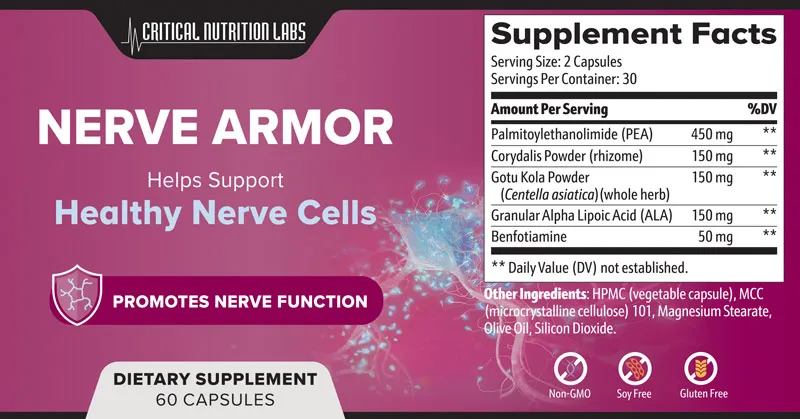
How to read a Supplement Facts panel
Start with serving size, because every amount below it refers to that quantity. In this case, one serving equals two capsules. Next, read each active ingredient and amount. The “Daily Value not established” notation means federal labeling has not set a Daily Value for those ingredients; it is not a statement about effectiveness or safety.
Why “other ingredients” still matter
Inactive or excipient ingredients can affect people with specific sensitivities or dietary preferences. They also tell you something about the capsule format and manufacturing. The Nerve Armor panel lists an HPMC vegetable capsule along with microcrystalline cellulose, magnesium stearate, olive oil and silicon dioxide.
Front-label claims vs. facts-panel facts
The front of a bottle is marketing space; the Supplement Facts panel is structured regulatory labeling. A phrase such as “helps support healthy nerve cells” is a structure/function statement, while “450 mg PEA per serving” is a quantitative label fact. Keeping those categories distinct helps prevent a marketing phrase from being interpreted as a clinical guarantee.
When a label image should be replaced
If the manufacturer changes ingredient amounts, serving size, other ingredients or allergen statements, this page should be updated. Old label images should not remain online simply because they rank in search. That is why this build uses the product image supplied for the current project rather than an arbitrary image scraped from a third-party listing.
Per-serving amounts vs. per-capsule amounts
The panel reports amounts per two-capsule serving. If a reader wants to understand the nominal amount per capsule, simple division gives 225 mg PEA, 75 mg corydalis powder, 75 mg gotu kola powder, 75 mg ALA and 25 mg benfotiamine per capsule, assuming the contents are evenly distributed. The manufacturer labels the product per serving, so the official numbers on this site remain the two-capsule amounts.
Why “Daily Value not established” is common on supplement labels
Daily Values exist for many essential nutrients but not for every botanical, derivative or endogenous compound used in supplements. The absence of a Daily Value should not be interpreted as a recommended dose, a safety threshold or evidence that the ingredient is unusually potent.
What to do if your physical label differs
Use the label on the bottle you actually received as the immediate source for serving instructions and ingredients. Packaging revisions can occur. If the difference is substantial or unexpected, compare the seller information from your order and ask for clarification before use.
Other ingredients
The supplied panel lists HPMC (vegetable capsule), MCC (microcrystalline cellulose), magnesium stearate, olive oil and silicon dioxide.
Non-GMO, soy-free and gluten-free icons
The supplied label artwork displays icons for Non-GMO, Soy Free and Gluten Free. We reproduce those as label-reported product attributes rather than independent laboratory certifications.
Daily Value notation
The panel uses “** Daily Value (DV) not established” for the five listed active ingredients. This means there is no established Daily Value for those amounts on the label; it does not mean that a higher amount is necessarily better.
Why the label outranks marketing copy
For ingredient identity, serving size and per-serving amounts, the current label is the first source this site uses. Marketing copy can be useful for understanding how a seller positions a product, but it should not override the actual Supplement Facts panel.